| Lt Burton J Newmark P-51D POW |

 |  |  |  |


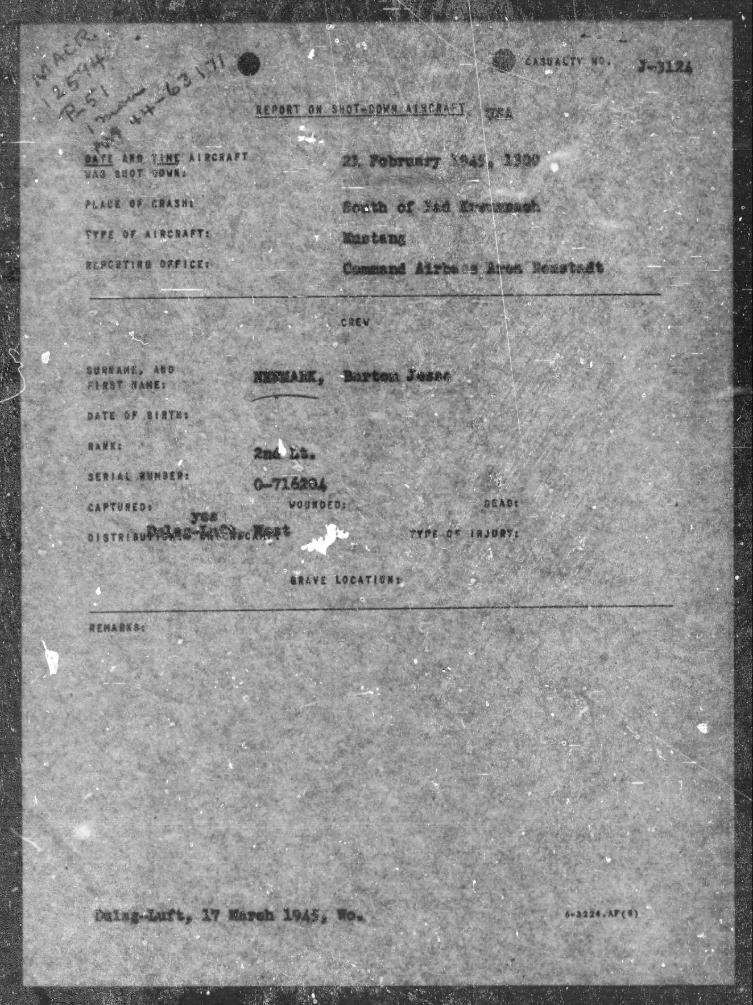

The following is an excerpt from a speech given by Burt Newmark to the Golden
Gate Wing of the Commemorative Air Force November 15, 2007
Link to Golden Gate Wing: http://goldengatewing.org/base/base.cfm
Target of Opportunity, February 21, 1945
By Christmas of 1944, Burt had switched aircraft, from his beloved P-47 to a P-51.
The aluminum skin of his Mustang sported the name ‘Lady Eve’, for his girlfriend of
that time, and nose art depicting a German helmet being conked by a rolling pin.
Two month’s later, he was with four dozen other pilots sitting in Hangar Three in a
briefing session for a mission to Nuremburg, Germany.
"The C-O, whoever was leading the group, would tell us our target, possible enemy
activity and timing. This mission was to escort bombers and to bomb the
marshalling yards in Nuremburg, which were very important to Germany, because
that’s where all traffic seemed to go through.
"The distance was probably 350 miles. The mission took about six hours."
Burt recalled the work of his crew chief Tom Vraible, who had been up two hours
earlier than Newmark, making sure the pilot’s aircraft was ready to perform its long
distance task.
With the seatbelt and shoulder harness in his P-51 cinched tight around him,
Newmark was mindful of three other Mustangs as the squadron took off four
abreast, nearly wingtip to wingtip, across the hard earth of the Duxford’s airfield.
The P-51s maintained close proximity as they penetrated winter cloud cover and
shared airspace with some 900 other fighters and 1400 bombers, all headed to the
same target.
The 78th climbed above the bomber stream, seeking out a group of B-17s with
boxed letters painted on their tails, marking them as members of the 3rd Bomber
Division. Being above the bombers would offer the P-51 escorts an advantage over
enemy fighters seeking to attack from out of the sun.
"The bombers were at about 23,000 -28,000 feet. We would fly at about 30,000,
and if we were called by our controller that there was any activity above us, we
would go up to about 40,000 feet.
"We wore gloves. The cockpit was heated, because you have heat coming off of
the engine. But your hands are on the side of the canopy and it’s about 40-degrees
below zero out there. The first glove was silk, the second was wool, and the third
glove was leather. Some guys still got some frostbite, but I worked out okay.
Newmark says as the bomber stream approached the marshalling yards at
Nuremburg, black puffs of antiaircraft fire began appearing around the aircraft.
Wings would come off bombers, engines would catch fire and crews would bail out
of crippled aircraft.
"Because no German fighters were going to fly though the flak, we left the
bombers. We picked them up on the other side of the target. We would then take
them back to the rendezvous point. If there was still no German activity, we would
go down on the deck and look for targets of opportunity, primarily trains. We
wanted to stop traffic going across to the front lines.
"We would break up into flights of four or two airplanes and go hunting across
Germany to see what we could find. We would shoot up trucks, tanks, and troop
movements… If we found an airfield, which I never did, we would shoot up
airplanes on the ground."
Newmark showed a photo of a strafing run he and his wingman made on a train.
He says that after he fired the P-51’s six .50 caliber machine guns at the steaming
locomotive, he pulled up to see what he had done.
"I heard my wingman yell, ’Flak car!’ The Germans, because their traffic was so
badly beaten up and destroyed, had started putting antiaircraft guns on their trains.
They were hidden until this thing would open up and there would be a gun."
Newmark said a single bullet had hit the cowling of his Mustang.
"I knew I was in trouble because I saw a little leak coming back alongside the
fairing. Within about three minutes, my engine was running rough. It was smoking
and then started on fire. I tried to climb as far as I could. I think I got up to about
1000 feet, before the fire started coming back through the firewall, so I knew I had
to bail out. I wasn’t about to try to ride down in a burning airplane.
"I thought I disconnected everything-I can’t remember how many things I was
connected to-and I went over the side. I had a little back pressure on the stick and
let go. I got caught halfway out of the cockpit and I blacked out, with smoke and
fire coming back at me. I actually had liquid aluminum pellets coming back at me
from the fire."
Newmark says he was fortunate to be conscious enough to pull the ripcord on his
parachute. He remembers the ‘chute opening, and then his feet immediately hit the
top of a tree. He hung from the tree for a few moments until managing to pull
himself to the trunk and slip down. But below, as he looked around the couple of
rows of trees, he saw he had a ‘welcoming’ committee.
"There was a crowd of farmers, I think, with pitchforks and shotguns, and there
was one man who seemed to be in the lead... I tried to crawl so they wouldn’t see
me.
Then I heard somebody yell, ‘Halt!’ I think he was a hunter out in the field, and he
was aiming right at me. So of course, I surrendered."
"The head guy, I think he was home guard, because he had some kind of a
uniform, but he wasn’t really a soldier. He asked me for my .45, took it from me
and asked me to show him how to shoot it. I showed him how to take the safety
off, and he fired it into a hill."
Newmark says his captor was so pleased with the gun that he used his pocket
knife to remove the .45’s clear plastic handle covering a picture of Bert’s girlfriend,
Eve, and gave the picture back to the pilot. Then, Newmark was taken into the
town of Kriegsfeld, escorted by two uniformed soldiers, who took him ‘visiting’.
For many Allied bomber crews and even some fighter pilots, being captured in or
near a town that had been bombed meant abuse or possibly death at the hands of
the locals. Newmark was fortunate that Kriegsfeld had been untouched by bombs.
"The people really were very nice. I was part of the party. We would sit down and
they would serve tea. We’d all be sitting and I could tell these two guys would be
telling this couple that they had shot me down, and they were making quite a story
of it!"
Prisoner of War
The visits went until late night, about 11 o’clock. Newmark says by then he was
beside himself, tired and scared, and sure that he was going to be taken out in the
woods and shot. Instead, he was taken and put on a train to Frankfurt. There he
was transported to the little town of Oberursel.
"I was put into a little solitary cell. Mine didn’t have a window or a table. It had a
cot and a pot. I just laid down on this thing and went fast asleep. I don’t know how
long I slept. I was really out of it. A guard knocked and brought me a bowl of soup,
a little later on, and I went back to sleep. Then the guard came back and said,
‘come with me.’
"He walked me to an office down the hallway. And in this office was this gentleman.
His name was Hanns Joachim Scharff. Hanns looked at me and he said, ’What are
you doing in my country?’ "
The pilot says he replied, "Burt Newmark. Second Lieutenant. 716204."
Scharff responded, "Why are you telling me that?"
Newmark said, "My government told me that’s all I need to tell you to prove I’m a
soldier."
According to Newmark, Scharff told him that was incorrect. The interrogator
reached behind him to pull a book off a shelf and open it, stating, "The Geneva
Convention says that that is not sufficient to prove you are a soldier."
"If you don’t believe me, look at my dogtags," said Newmark.
"Would you like to look at my dogtags. I’m Colonel Bullshit. You arrive at my
country by parachute. You’re not wearing a uniform. You’re a spy, and I’m going to
have you shot," said Scharff.
Newmark, seeing Scharff motion to a guard by the door, countered. "No, no, you
can’t do that. Your people saw my parachute in the tree. They saw my airplane
burning on the ground. Spies don’t fly airplanes like that."
"Oh," said Scharff, "you’re a flier. Look, for you the war is over. For me the war is
going to be over in three months. My wife is living in New York, on Riverside Drive.
She’s buying American war bonds…"
Newmark says he thought, "What kind of crap is this?"
Scharff continued, "If you will tell me the two letters on the side of your airplane we’
ll see what we can do for you."
Knowing the Germans had seen the airplane and should have noted its coded
fuselage, Newmark replied,"W-Z."
"Oh, the 84th Squadron," Scharff shot back. "How is Ray Smith?"
Ray Smith, Newmark recalled, had been in an accident at Duxford, had crash-
landed and was recovering from some cuts. Newmark was surprised and in
disbelief that Scharff would know this.
Newmark has a copy of a document Scharff created and signed. It is marked with
a "J" for jager (fighter) and "H" for Hebrew. During the conversation Scharff also
said, "Because you have an "H" on your tag, if I turn you over to the SS, it would be
very, very bad for you."
On a motion from Scharff, the guard took Newmark from the office. Soon he was
being transported to a Prisoner of War camp near Nuremburg, about eight miles
from the railroad marshalling yards targeted by the B-17s Newmark had been
escorting.
British, Dutch and American flying officers populated the camp, and conditions,
Newmark says, were not too bad. The first thing he was told was to take a burlap
bag outside and fill it with pine needles. The bag was then laid on four wooden
slats on a bunk frame, his bed for his 2-1/2 months in the camp.
"We didn’t get much food. It was terrible and very rare. We did get Swiss prisoner
of war packages. I think I got two in the entire time there. These things were
fantastic because they contained American cigarettes. We had an escape
committee that used the cigarettes to get from the German guards guns, radios
and wire cutters.
"We were all concerned the Germans would kill us rather than doing something
else. We had a plan that we would take the guns we had and shoot a couple of
soldiers. Then we’d have four guns. And just keep trying to expand that and maybe
that would save us."
Newmark said one night, a mixed group of POWs compared notes on precision
bombing techniques. One of the British pilots offered his explanation:
"First thing we do is send a pathfinder over the target area. The pathfinder drops a
white flare over the target. In the light of that white flare, a Mosquito drops a red
and green cascading flare in the center of the target.
"For hours, our bombers will come in individually at different altitudes, from different
directions and drop their bombs on the red and green cascading flare. And that
flare will be renewed by Mosquitos when necessary."
Newmark recalled that about that time, an air raid siren went off. The POWs went
running outside and saw a red and green cascading flare floating down over the
marshalling yards. Right after that, two Mosquitos came down to drop white flares
around the prison camp.
"That was the first time we knew that somebody knew who we were and where we
were. And all night long, just as he had said, British bombers came in, one at a
time, from different directions dropping bombs. And some of them were delayed
action bombs, so that the Germans couldn’t get the repair crews in too quickly. So,
that marshalling yard was pretty badly damaged."
As the spring of 1945 approached, the POWs in the Nuremburg camp found
themselves being moved to Moosberg near the Bavarian Alps. It was a forced
march of some 90 miles along German roads that had been bombed. The POWs
were given parcels of basic provisions and then set off on foot with guards.
Newmark says the trek took him twelve days, while some POWs were faster and
some, slower. There was little in the way of sustenance on the march.
"We had to scrounge eggs from old farmyards where maybe there were a couple
of chickens still alive. Aside from that we had very little to eat. I lost about 35
pounds during my 2-1/2 months in prison camp.
"One of the things that happened as we were marching along this roadway, we
were crossing a railroad line. There was a big lumberyard right near the line, and a
train parked right outside the lumberyard. Just as we crossed the tracks, someone
looked up and said, "Oh look. Four Me 109s."
"Somebody else said, ‘109s, hell! Those are P-47s!’ "
Newmark says that just as those words were spoken the P-47s started to dive on
the train. The POWs ran for the logs for protection.
"Those guys came down and wrecked the train, killed two of the prisoners of war.
A couple of guys were wounded. And I’ve never heard from the ground side what
strafing sounds like. If you picture 700 rounds a minute out of eight guns, with four
airplanes, hitting the ground-each bullet sounded like a sledgehammer hitting the
ground. It was just incredible. You just can’t imagine what it sounded like."
It was late April 1945 when Newmark and the rest of the POWs had made it to the
Moosberg camp, and another sound made an indelible mark on his memory. A
deep rumble on that day heralded the arrival of armored vehicles. The sound of U.
S. 3rd Army tanks made the Moosberg guards take off, and drew the POWs to the
front gate.
"A tank came up nearby and the tank commander motioned everybody away. He
was instructed, apparently, not to lift the hasp that held the gate closed. They ran it
over with the tank. And guess who the guy was who asked them to do that. It was
General George Patton…"
The liberated Allied pilots were taken to Camp Lucky Strike, which Newmark
describes as being almost worse than the prison camps. But after he was there for
two weeks, Newmark and his buddy, Ewing Miller got up on the roadway and
hitched a ride with two officers driving a jeep into Paris.
"You can imagine, as the war was ending, what Paris was like. And the worse
thing that happened to me in the war was that I came down with infectious hepatitis
that night and they put me into the hospital.
"Fortunately, I was able to talk to a reporter before I went into the hospital and he
said he’d send my name home. And my mother did get this telegram that said I
was okay. "
The hospital stay lasted a week, before Newmark was transported to a hospital
ship for an eight-day cruise back to America.
Used with permission of and copyright of the Golden Gate Wing Commemorative
Air Force
Gate Wing of the Commemorative Air Force November 15, 2007
Link to Golden Gate Wing: http://goldengatewing.org/base/base.cfm
Target of Opportunity, February 21, 1945
By Christmas of 1944, Burt had switched aircraft, from his beloved P-47 to a P-51.
The aluminum skin of his Mustang sported the name ‘Lady Eve’, for his girlfriend of
that time, and nose art depicting a German helmet being conked by a rolling pin.
Two month’s later, he was with four dozen other pilots sitting in Hangar Three in a
briefing session for a mission to Nuremburg, Germany.
"The C-O, whoever was leading the group, would tell us our target, possible enemy
activity and timing. This mission was to escort bombers and to bomb the
marshalling yards in Nuremburg, which were very important to Germany, because
that’s where all traffic seemed to go through.
"The distance was probably 350 miles. The mission took about six hours."
Burt recalled the work of his crew chief Tom Vraible, who had been up two hours
earlier than Newmark, making sure the pilot’s aircraft was ready to perform its long
distance task.
With the seatbelt and shoulder harness in his P-51 cinched tight around him,
Newmark was mindful of three other Mustangs as the squadron took off four
abreast, nearly wingtip to wingtip, across the hard earth of the Duxford’s airfield.
The P-51s maintained close proximity as they penetrated winter cloud cover and
shared airspace with some 900 other fighters and 1400 bombers, all headed to the
same target.
The 78th climbed above the bomber stream, seeking out a group of B-17s with
boxed letters painted on their tails, marking them as members of the 3rd Bomber
Division. Being above the bombers would offer the P-51 escorts an advantage over
enemy fighters seeking to attack from out of the sun.
"The bombers were at about 23,000 -28,000 feet. We would fly at about 30,000,
and if we were called by our controller that there was any activity above us, we
would go up to about 40,000 feet.
"We wore gloves. The cockpit was heated, because you have heat coming off of
the engine. But your hands are on the side of the canopy and it’s about 40-degrees
below zero out there. The first glove was silk, the second was wool, and the third
glove was leather. Some guys still got some frostbite, but I worked out okay.
Newmark says as the bomber stream approached the marshalling yards at
Nuremburg, black puffs of antiaircraft fire began appearing around the aircraft.
Wings would come off bombers, engines would catch fire and crews would bail out
of crippled aircraft.
"Because no German fighters were going to fly though the flak, we left the
bombers. We picked them up on the other side of the target. We would then take
them back to the rendezvous point. If there was still no German activity, we would
go down on the deck and look for targets of opportunity, primarily trains. We
wanted to stop traffic going across to the front lines.
"We would break up into flights of four or two airplanes and go hunting across
Germany to see what we could find. We would shoot up trucks, tanks, and troop
movements… If we found an airfield, which I never did, we would shoot up
airplanes on the ground."
Newmark showed a photo of a strafing run he and his wingman made on a train.
He says that after he fired the P-51’s six .50 caliber machine guns at the steaming
locomotive, he pulled up to see what he had done.
"I heard my wingman yell, ’Flak car!’ The Germans, because their traffic was so
badly beaten up and destroyed, had started putting antiaircraft guns on their trains.
They were hidden until this thing would open up and there would be a gun."
Newmark said a single bullet had hit the cowling of his Mustang.
"I knew I was in trouble because I saw a little leak coming back alongside the
fairing. Within about three minutes, my engine was running rough. It was smoking
and then started on fire. I tried to climb as far as I could. I think I got up to about
1000 feet, before the fire started coming back through the firewall, so I knew I had
to bail out. I wasn’t about to try to ride down in a burning airplane.
"I thought I disconnected everything-I can’t remember how many things I was
connected to-and I went over the side. I had a little back pressure on the stick and
let go. I got caught halfway out of the cockpit and I blacked out, with smoke and
fire coming back at me. I actually had liquid aluminum pellets coming back at me
from the fire."
Newmark says he was fortunate to be conscious enough to pull the ripcord on his
parachute. He remembers the ‘chute opening, and then his feet immediately hit the
top of a tree. He hung from the tree for a few moments until managing to pull
himself to the trunk and slip down. But below, as he looked around the couple of
rows of trees, he saw he had a ‘welcoming’ committee.
"There was a crowd of farmers, I think, with pitchforks and shotguns, and there
was one man who seemed to be in the lead... I tried to crawl so they wouldn’t see
me.
Then I heard somebody yell, ‘Halt!’ I think he was a hunter out in the field, and he
was aiming right at me. So of course, I surrendered."
"The head guy, I think he was home guard, because he had some kind of a
uniform, but he wasn’t really a soldier. He asked me for my .45, took it from me
and asked me to show him how to shoot it. I showed him how to take the safety
off, and he fired it into a hill."
Newmark says his captor was so pleased with the gun that he used his pocket
knife to remove the .45’s clear plastic handle covering a picture of Bert’s girlfriend,
Eve, and gave the picture back to the pilot. Then, Newmark was taken into the
town of Kriegsfeld, escorted by two uniformed soldiers, who took him ‘visiting’.
For many Allied bomber crews and even some fighter pilots, being captured in or
near a town that had been bombed meant abuse or possibly death at the hands of
the locals. Newmark was fortunate that Kriegsfeld had been untouched by bombs.
"The people really were very nice. I was part of the party. We would sit down and
they would serve tea. We’d all be sitting and I could tell these two guys would be
telling this couple that they had shot me down, and they were making quite a story
of it!"
Prisoner of War
The visits went until late night, about 11 o’clock. Newmark says by then he was
beside himself, tired and scared, and sure that he was going to be taken out in the
woods and shot. Instead, he was taken and put on a train to Frankfurt. There he
was transported to the little town of Oberursel.
"I was put into a little solitary cell. Mine didn’t have a window or a table. It had a
cot and a pot. I just laid down on this thing and went fast asleep. I don’t know how
long I slept. I was really out of it. A guard knocked and brought me a bowl of soup,
a little later on, and I went back to sleep. Then the guard came back and said,
‘come with me.’
"He walked me to an office down the hallway. And in this office was this gentleman.
His name was Hanns Joachim Scharff. Hanns looked at me and he said, ’What are
you doing in my country?’ "
The pilot says he replied, "Burt Newmark. Second Lieutenant. 716204."
Scharff responded, "Why are you telling me that?"
Newmark said, "My government told me that’s all I need to tell you to prove I’m a
soldier."
According to Newmark, Scharff told him that was incorrect. The interrogator
reached behind him to pull a book off a shelf and open it, stating, "The Geneva
Convention says that that is not sufficient to prove you are a soldier."
"If you don’t believe me, look at my dogtags," said Newmark.
"Would you like to look at my dogtags. I’m Colonel Bullshit. You arrive at my
country by parachute. You’re not wearing a uniform. You’re a spy, and I’m going to
have you shot," said Scharff.
Newmark, seeing Scharff motion to a guard by the door, countered. "No, no, you
can’t do that. Your people saw my parachute in the tree. They saw my airplane
burning on the ground. Spies don’t fly airplanes like that."
"Oh," said Scharff, "you’re a flier. Look, for you the war is over. For me the war is
going to be over in three months. My wife is living in New York, on Riverside Drive.
She’s buying American war bonds…"
Newmark says he thought, "What kind of crap is this?"
Scharff continued, "If you will tell me the two letters on the side of your airplane we’
ll see what we can do for you."
Knowing the Germans had seen the airplane and should have noted its coded
fuselage, Newmark replied,"W-Z."
"Oh, the 84th Squadron," Scharff shot back. "How is Ray Smith?"
Ray Smith, Newmark recalled, had been in an accident at Duxford, had crash-
landed and was recovering from some cuts. Newmark was surprised and in
disbelief that Scharff would know this.
Newmark has a copy of a document Scharff created and signed. It is marked with
a "J" for jager (fighter) and "H" for Hebrew. During the conversation Scharff also
said, "Because you have an "H" on your tag, if I turn you over to the SS, it would be
very, very bad for you."
On a motion from Scharff, the guard took Newmark from the office. Soon he was
being transported to a Prisoner of War camp near Nuremburg, about eight miles
from the railroad marshalling yards targeted by the B-17s Newmark had been
escorting.
British, Dutch and American flying officers populated the camp, and conditions,
Newmark says, were not too bad. The first thing he was told was to take a burlap
bag outside and fill it with pine needles. The bag was then laid on four wooden
slats on a bunk frame, his bed for his 2-1/2 months in the camp.
"We didn’t get much food. It was terrible and very rare. We did get Swiss prisoner
of war packages. I think I got two in the entire time there. These things were
fantastic because they contained American cigarettes. We had an escape
committee that used the cigarettes to get from the German guards guns, radios
and wire cutters.
"We were all concerned the Germans would kill us rather than doing something
else. We had a plan that we would take the guns we had and shoot a couple of
soldiers. Then we’d have four guns. And just keep trying to expand that and maybe
that would save us."
Newmark said one night, a mixed group of POWs compared notes on precision
bombing techniques. One of the British pilots offered his explanation:
"First thing we do is send a pathfinder over the target area. The pathfinder drops a
white flare over the target. In the light of that white flare, a Mosquito drops a red
and green cascading flare in the center of the target.
"For hours, our bombers will come in individually at different altitudes, from different
directions and drop their bombs on the red and green cascading flare. And that
flare will be renewed by Mosquitos when necessary."
Newmark recalled that about that time, an air raid siren went off. The POWs went
running outside and saw a red and green cascading flare floating down over the
marshalling yards. Right after that, two Mosquitos came down to drop white flares
around the prison camp.
"That was the first time we knew that somebody knew who we were and where we
were. And all night long, just as he had said, British bombers came in, one at a
time, from different directions dropping bombs. And some of them were delayed
action bombs, so that the Germans couldn’t get the repair crews in too quickly. So,
that marshalling yard was pretty badly damaged."
As the spring of 1945 approached, the POWs in the Nuremburg camp found
themselves being moved to Moosberg near the Bavarian Alps. It was a forced
march of some 90 miles along German roads that had been bombed. The POWs
were given parcels of basic provisions and then set off on foot with guards.
Newmark says the trek took him twelve days, while some POWs were faster and
some, slower. There was little in the way of sustenance on the march.
"We had to scrounge eggs from old farmyards where maybe there were a couple
of chickens still alive. Aside from that we had very little to eat. I lost about 35
pounds during my 2-1/2 months in prison camp.
"One of the things that happened as we were marching along this roadway, we
were crossing a railroad line. There was a big lumberyard right near the line, and a
train parked right outside the lumberyard. Just as we crossed the tracks, someone
looked up and said, "Oh look. Four Me 109s."
"Somebody else said, ‘109s, hell! Those are P-47s!’ "
Newmark says that just as those words were spoken the P-47s started to dive on
the train. The POWs ran for the logs for protection.
"Those guys came down and wrecked the train, killed two of the prisoners of war.
A couple of guys were wounded. And I’ve never heard from the ground side what
strafing sounds like. If you picture 700 rounds a minute out of eight guns, with four
airplanes, hitting the ground-each bullet sounded like a sledgehammer hitting the
ground. It was just incredible. You just can’t imagine what it sounded like."
It was late April 1945 when Newmark and the rest of the POWs had made it to the
Moosberg camp, and another sound made an indelible mark on his memory. A
deep rumble on that day heralded the arrival of armored vehicles. The sound of U.
S. 3rd Army tanks made the Moosberg guards take off, and drew the POWs to the
front gate.
"A tank came up nearby and the tank commander motioned everybody away. He
was instructed, apparently, not to lift the hasp that held the gate closed. They ran it
over with the tank. And guess who the guy was who asked them to do that. It was
General George Patton…"
The liberated Allied pilots were taken to Camp Lucky Strike, which Newmark
describes as being almost worse than the prison camps. But after he was there for
two weeks, Newmark and his buddy, Ewing Miller got up on the roadway and
hitched a ride with two officers driving a jeep into Paris.
"You can imagine, as the war was ending, what Paris was like. And the worse
thing that happened to me in the war was that I came down with infectious hepatitis
that night and they put me into the hospital.
"Fortunately, I was able to talk to a reporter before I went into the hospital and he
said he’d send my name home. And my mother did get this telegram that said I
was okay. "
The hospital stay lasted a week, before Newmark was transported to a hospital
ship for an eight-day cruise back to America.
Used with permission of and copyright of the Golden Gate Wing Commemorative
Air Force