| First Hand Accounts of being in Marinduque during the war |
 |
 |
 |
 |
 |
 |
 |
| Letters home helped to document what the soldiers saw while they were in Marinduque. There were also correspondents from weekly magazines that visited and wrote about what they saw. |
| The Outlook Magazine New York CityAugust 18, 1900 The Occupation of Marinduque By Phelps Whitmarsh Special Commissioner for The Outlook in the Philippines After a man has given the romantic years of his life to the sea, has served a full apprenticeship, and has earned the title of sailor, he never feels the heave and send of even the smallest of craft beneath him that he does not at once become confident, and at once become what we call at home. And to the man who has forsaken his boyish ideal and taken up the more complicated life of a landsman, every whiff of salt water stirs his memory as no perfume can, revives his romance, makes him a boy again. More than all, perhaps, is the comforting knowledge that he and the sea understand each other-that they are old friends. It was with much content, therefore, that, after so much of the mountains and the plains, I found myself aboard the transport Indiana, leaving the sweltering Bay of Manila for a cruise to the southward. I say cruise because our ports were by no means definite, nor could they well be so; for, in addition to landing army supplies at various points, we carried an expeditionary force-a battalion of the Twenty-ninth Infantry, U. S. V., and, though the orders were supposed to be secret, we all knew that they were going out to take islands. What and where these islands were we did not know; but it was certain that the vessel was under Colonel Hardin's orders until the mysterious islands were in American hands. All of which was rather interesting. At the long table in the saloon some sixty of us sat down to dinner. We were placed in the usual military fashion, according to rank. The Colonel and the ship's captain had the head of the table, and then, in turn, came the majors, the captains, the lieutenants, the contract doctors, the interpreter and Visayan pilot, and, lastly, the few civilians not connected with the expedition. Hello, Benguet said a voice as I was passing to my seat. It was Lieutenant Fuqua, under whose escort our party had passed through northern Benguet, and whose blanket I had shared on not a few cold nights. Well, tramp! Bet you don't remember me, said the next man, holding out his hand. I think I do. Dr. Herrmann, isn't it ? Met you in Cuba. You gave me a much needed breakfast at Sancti Spiritus at the smallpox hospital a year or so ago. Yes. I have a pencil-sketch of your beautiful mule still. A little further on I got a gentle poke in the ribs and the salutation, Hola, amigo I Quetal? This from the patriotic and big-hearted Dr. Xeres y Burgos,'the friars' friend, whom I had known in Manila for some time. Almost opposite Dr. Xeres, I recognized Chaplain Miller, of the Fourth Cavalry, the broadest of parsons and the best of fellows. And when, at last, I sat down, it was to find in my right-hand neighbor another friend. Thus it is in the Philippines-one gets to know everybody. In the good old days when expeditions sallied forth to conquer islands and things, I suppose they experienced all kinds of hardships, were very uncomfortable, and all that sort of thing; but as I looked along the table, lighted and fanned by electricity, furnished with an unlimited amount of that great Philippine luxury, ice water and supplied from the refrigerator with American fowls and meats, vegetables and fruits, I felt that things had changed. It was very pleasant, but it upset one's notions about war. There was not even a suggestion of war. It reminded me of what I saw in Angeles when General MacArthur took me round the firing-line and I saw hot soup, beef, potatoes, and rice-pudding being served to the men from a carabao cart. Imagine it! Hot dinner served on the firing-line! I have seen a good deal of the United States army in the Philippines, and I am convinced of one thing-that it is the best fed, the best paid, and the best supplied army on earth. The Indiana did not get under way until late that night, but the cool, delightful breeze kept most of us a wake until the Cavite lights had gone out and the steady glare of Corregidor was far astern. Then, the cabins being insufferably hot, we brought up our blankets, and camped under the stars. On the port side, so close that we could hear the unseasonable crowing of cocks and barking of dogs, and could catch the subtle, earthy odor which rises with the night dew, rose the bold shore of Cavite Province. Soon all was quiet. Nothing but the regular throb of the engines and a gentle rustle over the bow gave evidence that the vessel was moving. It seemed as if she were feeling her way along the coast alone. Early next morning we dropped anchor in the Bay of Batangas, in sight of Taal Volcano, where we remained three days discharging commissary and quartermaster's supplies. Though Batangas is the second port in Luzon, there were absolutely no facilities for loading or unloading vessels. Everything was landed on the beach in long, narrow dugouts-three armed guards and four boxes being the usual load. Batangas is called the worst town in the worst province. The people are Tagalogs, rather darker than those of the middle provinces, and decidedly less reconcilable to American rule. With Dr. Xeres I visited the leading natives of the town, and, owing to my companion, I had an opportunity of hearing a truthful expression of their views. All, even though they were under military protection, and diplomatically professed friendship, were most bitter in their denunciation of the Americans. It was patent that these people, like the majority of the inhabitants of Luzon, submitted only when there was no alternative; and that in their hearts enmity toward the white race, for it is no longer solely the American, is strong. Seven months, I believe, the town had been occupied by United States forces, and yet the greater part of the people were still in the mountains; no municipal government had been established, for no one would accept office; schools were unthought of, guerrilla warfare was rife throughout the province, and no white man was safe one hundred yards beyond the outposts. It. is such things as these, such glimpses of native sentiment as this, that make one believe that an army, aye, and no small one, will be necessary in the Philippines for a generation to come. Batangas, before the last insurrection, was a rich town, the center of-the best sugar district in Luzon, and also the largest coffee-growing district. Batangas coffee is of excellent quality, only equaled by the Benguet product. At the time of my visit, however, most of the coffee plantations were ruined-partly by neglect brought on by war, but principally by the visitation of an insect which killed the trees; sugar production had been reduced by more than one-half, and the population of the town had shrunk from twenty thousand to three thousand. While we were being driven through the grass-grown side streets, we came upon a part which had been burned, and we asked our driver about it. No, he said,it was not an accidental fire. The Americans had done it. What for? I inquired. I do not know, senor, he replied. It is not possible that so many houses would be destroyed without good reasons. But it is true, senor. All they found was one soldier lying between the houses. An American soldier ? Yes, senor. Was he wounded? No, senor, he was not wounded. He had no head. This was by no means a joke-for the Filipino is not given to joking-but was told us in the most grave, matter-of-fact way. The utility of that homely, snail-like, exasperating but indispensable animal, the carabao, was clearly exemplified in Batangas. The beasts were harnessed to rude bamboo rafts furnished with runners and freighted with raw sugar, and driven down the river to the sea. In the shallow parts of the stream they dragged the rafts; in the deeps they swam. Nor did they stop at the river-mouth, but continued along the shore until they reached the landing bancas. A carabao, with only its nose and horns out of water, towing a pile of sugar with a half-naked boy perched atop of it, who steers with a line made fast to the animal's nose-ring, is a novel and an amusing sight. By using the riverbed instead of the poor roads, the native brings all the powers of his amphibious beast of burden into play, and saves himself a good deal of time and trouble. In such ways, in anything which will lighten his own labor, the Filipino is ingenuity itself. While we lay in Batangas Harbor, the United States ship Helena and the gunboat Villalobos came in and anchored near us. It soon became known that these two ships of war were to accompany us, and that the expedition's first work was to take the island of Marinduque. What opposition the insurrectionists, who had a government of their own for nearly two years, were likely to offer no one knew. It was reported, however, that the beach near Boac, the capital, was well intrenched, and that the most determined fighters in the island were there to be found. Toward Boac, therefore, the three vessels were headed, the Helena being in the lead and the Villalobos following us. The cloud-bank which at daybreak next morning darkened the east became land when the sun rose behind it; at seven o'clock it was a tropical island teeming with vegetation, and right ahead of us lay a strip of yellow beach with a cluster of nipa-thatched houses nestling beneath a roof of tossing cocoa-palms. By the time the anchors of the little fleet went rattling to the bottom of the bay the line of trenches was visible, and we could see many white-shirte'd figures scurrying about among the trees; also a solitary man on horseback. B and C companies piled into the landing boats, there was not a little excitement, and the burning question of the hour was, Will they fight? Before a start was made, however, a lone native came running down to the end of the sand-spit, and, mounting an overturned banca, he took off his white trousers (his only garment) and waved them at us. At this the hopes of the Twenty-ninth died; for, although a man who takes off his coat may mean war, he who unbreeches himself is invariably pacific. Notwithstanding the novel flag of truce, the landing was made according to the original plan, and a very pretty landing it was, in spite of the fact that not a shot was fired. Led by Colonel Hardin, the men leaped from the boats as they neared the shore, and, deploying, they took the trenches both on the flank and in the rear. Then, with a shrill and distinctively American yell, the Stars and Stripes went up, and the rule of the insurrectos in Marinduque was ended. It was all very pretty, but, unfortunately, as the Twentyninth said, very tame. It was neither as exciting as a sham battle at Aldershot, nor as interesting as a comic opera, though it was suggestive of both. As we marched through the pretty village of Lai Lai, in the shade of a lofty palm grove, the few people who had not fled hastily threw out little white flags, shirts, handkerchiefs, chemises, floursacks, any rag, indeed, that was or had once been white. Except this show of fear, they made no demonstration whatever, and it was impossible to judge from their appearance what our reception would be at Boac, which lies three miles inland. Everywhere as we progressed we found model trenches and other evidences that a determined resistance had been planned; but since these model trenches were empty, and the scouts and flankers stirred up nothing more than a few grazing carabaos, it was also evident that the plans at the last moment had been abandoned. In all parts of the Philippines it is the same. Trenches, splendid ones, guard the seacoasts, the roads, the towns, the river-crossings, and the mountain passes; the work that has been done in thus preparing for war is, for these people, enormous, and at the same time ridiculous; for if they do not leave their defenses before the enemy's approach, which is usually the case, the first American yell produces a vision of flying shirt-tails. When one sees the magnificent opportunities the Filipinos have had, and thrown away, it quite makes one out of patience with them. Bravery, even though it be wrongly applied, has ever in it something admirable, but one can have nothing bu.t contempt for the man who is both a fool and a coward. An hour's march along a road arched with glossy mangoes and nangkas, cocoa and betel palms, bread-fruit, cacao, coffee, pomegranate, a species of citrus laden with large green spheres, and other profitable fruit-trees, with occasional glimpses of rice-flats and hills of foliage, and sundry bursts of color from the poincianas and hibiscus, brought us to the charming little town of Boac. At first we thought it deserted, for the streets and the square were empty and every door and window closed; but we had hardly come to this conclusion when we were hailed from an upper window in our own tongue and welcomed to the town by an Englishman-the inevitable Englishman. Inevitable, because it does seem as if he were not to be avoided. Probe into the heart of the darkest continent, land on the most desolate island, explore the least-known region, climb the highest peak or descend the ocean depths, and an Englishman rises before you and, in the most matter-of-fact way and with an unmistakable accent, bids you good-day. The Boac Englishman, being of a speculative turn, had sailed over from Luzon in an open boat with $5,000 in silver (300 Ibs.) for the purpose of buying hemp before the ports were opened. After fighting a school of sharks en route and passing thirty-six hours without food, water, or shelter, he arrived off the beach at Lai Lai and was at once made a prisoner. In this condition he had remained until our arrival, when he was placed in the house of the richest native as a protector; the natives knowing well that a house with a white man in it would neither be fired upon nor sacked. To the credit of the natives of Marinduque it must be said that, though guarded, he was allowed to carry on his business and was not robbed of a single cent. In the rapid search that was made of the town, a few old muzzle-loading rifles and flint-locks were found, a great store of new bows and arrows, and an evil-looking Recoleto friar, who had been held prisoner for two years. As soon as they could be found, messengers were dispatched to the neighboring country with assurances of good will and promises of protection to all those who would return to their houses. The next day the frightened inhabitants began to come in, and within three days, by means of a diplomatic correspondence opened up between Colonel Hardin and the representatives of the so-called Filipino Government, Martin Lardizabal, the Governor, appeared. A conference was held aboard the Helena, which resulted in four out of five of the island towns-being peacefully surrendered. Santa Cruz, the remaining town, was taken without opposition by Major Case, who marched across the island, while the fleet sailed round to the same point. While these things were going on, I had an opportunity of seeing something of Marinduque. The island rises in the center of a number of tree-clad mountains, and is throughout a delightful jumble of vales and peaks of surpassing greenness and beauty. Roughly speaking, it is about twenty-five miles square. It is divided into five townships-Boac, Santa Cruz, Mogpog, Gasan, and Torrijos-and has some forty-five thousand inhabitants, all of whom are Tagalogs, though their language is slightly mixed with Visayan and Bicol. Unlike the Tagalogs of Luzon, however, the people are a peaceful, humble lot, submissive to authority, and unusually diligent. They are, moreover, lighter colored and physically superior to their tribal relatives. In many respects, indeed, Marinduque is an exceptional island. The chief product, hemp, is of a quality unequaled in the archipelago. It is known as kilot, and is an unusually fine, white, and strong fiber, which brings five to six dollars more per picul than ordinary hemp. Kilot is used wholly for weaving into fabrics. Primitive hand-looms can be seen in most of the houses, and the greater part of the clothes worn are made by the women from material woven by themselves. Marinduque also produces a fair quantity of rice, copra (dried coconut), and arrowroot. Though the island has never been prospected for minerals, and the natives are ignorant on the subject, it is asserted that copper, gold, and lead are to be found in the mountains. I was shown specimens of galena which proved the existence of one large vein. Hot sulfurous springs, which are panaceas for native ailments, exist in many parts, and petroleum, also, is said to be present. Caves of great size are common, not only in Marinduque, but in the adjacent islands. In the group known as the Three Kings, Gaspar is said to be undermined by one immense cavern. From the many skeletons discovered in these caves it is generally supposed that in some former age they were used as burial-places; and the gold fillings in the teeth of the skeletons, the gold ornaments made in the shape of a leaf, and various kinds of pottery also found seem to point to an ancient civilization of no mean order. At least they open up a world of speculation. The island abounds in animal and bird life-of pigeons alone there are thirty species-and the butterflies were especially noticeable. In the way of architecture, the most interesting thing in Marinduque is the old fortified church and convento at Boac, which occupies the summit of a small hill in the center of the town, It was built about 1690, under the direction of the friars, as a protection against the piratical Moros, who until within almost recent years looked upon these outlying islands as their lawful prey. It is less than thirty years in fact, since these sea-robbers last landed in Marinduque and looted the town of Santa Cruz. Within the massive walls of this island fort, which was intended to be both cannon and earthquake proof, the entire population of the town can be gathered. It is one of the most picturesque structures in the Philippines, thoroughly mediaeval in design as well as in appearance; for the ravages of a moist, tropical climate have clothed it with a growth of parasites, mellowed and aged it far beyond its years. The church within the walls is a fine large building in excellent repair. Twice during my stay in Boac I slept on its fine hardwood floor, with the gaudy pyramid of wooden images that backed the altar in front of me, a famous black Christ to my left, and on my right, done in wax, a veritable chamber of horrors. In spite of its well-appointed church, however, Boac had been without a priest for several months. The last incumbent, a native, had robbed the people to such an extent that they had forcibly ejected him. Not content with the usual church fees, which in such a parish must have been large, he instituted a system of fines, one, for instance, for coming into church late, and forced payment by refusing to confess, absolve, or perform any religious rite until the fines were paid. He was worse, the people said, even than the friar before him. As a punishment for this wickedness, the Archbishop of Manila had excommunicated the whole parish; and the people, overjoyed at the freedom thus given, then declared themselves in favor of an American minister. They said freely that they did not care whether he was a Catholic or a Protestant or anything else so long as he could perform the baptismal, marriage, and burial ceremonies. All whom I talked with stated that they were willing to welcome anyone but a fraile. To this one thing, if to nothing else, the Filipino is constant-his hatred of the friars. While riding along the sandy, palm fringed road to Gasan one morning, I noticed several men pass with great cane pitchers hooked over their shoulders, and I asked my guide what they contained. Upon learning that it was tuba, the common drink of the island, I expressed a wish to try it. We pulled up, therefore, at the next house in a coconut grove, and I seated myself in the grateful shadow of the fanlike foliage, while one of the numerous boys of the household, with a bamboo slung over his shoulder, went aloft. Grasping the trunk of the palm with his hands and placing his feet in the notches cut in both sides of the tree, he climbed or rather walked up a perpendicular fifty-foot bole with as little exertion, apparently, as we would have in going up-stairs. Just below the great shining leaves' there ran from tree-top to tree-top, and thus connected the 'whole group, a double row of bamboos-the lower one to walk on, the upper to serve as a handrail. By this means the little tuba gatherer sped from one tree to another, emptying each receiver he came to until his own measure was full. Then he came down, and, after the flies and insects had been strained out by means of a bunch of hemp, I had my first taste of tuba. It is not at all an unpleasant drink when fresh; something like small-beer-a little sharp and yet sweet. Though its natural color is a milky white, it becomes brown when a ferment is used with it. Tuba is the sap of the cocoa-palm, and is obtained by cutting off a leaf within a foot or so of the trunk and tying a bamboo receiver on the end. In Marinduque it is customary to place a small quantity of powdered bichi bark in the receiver, so that as the sap drips it also ferments. The end of the cut leaf requires occasional trimming, lest the pores clog and nature should heal the wound; but beyond this no care is necessary. The contented native sits en cuclillas (on his heels) in the shade of his grove, chews his beloved betel, and thinks (oh! happy mortal) of nothing. Meanwhile the fruit falls to his hand, his wife works, and free beer is always on tap. How, I asked my host, whose name was Anastasio, how do you live? He answered nothing, but pointed with his lips (a common Filipino fashion) to the trees above. Is it possible that you can keep a family, and I see you have a horse as well, on so small a grove as this? You cannot have more than two hundred trees. It is possible, senior. What sized family have you ? Nine children [he checked them off on his fingers], my wife, my wife's sister, my son's wife and baby, and a cousin altogether fourteen. How much money do your trees bring you in during the year ? I do not know, senor, but sufficient. And you are contented ? His little black eyes opened with indolent surprise; then, slowly emptying his mouth of a lake of red saliva, he inquired, Why not? Yes, indeed, why not? His innocent question set me thinking. Two hundred coconut-trees gave Anastasio and his large family food, drink, raiment, and shelter. His house, save for the strip bamboo floor, which he cut from the clump across the road, was thatched and fashioned wholly from his own palms. They gave him oil for frying and for anointing the family hair, fiber for ropes, material for petates and hats, husks for fuel, and tuba to exchange with the fisherman for fish and to drink his own and his friends' health. The sale of the green nuts and the copra furnished him with enough money to buy rice, hemp, and cotton for his wife's loom, a few luxuries, and still left him a little to gamble with. Half a dozen betel palms, a few buyo vines, and lime burned from the coral rocks of the beach gave him the materials for his indispensable chew; his salt he evaporated from sea-water; his fowls and pigs grew fat and multiplied upon food supplied by nature; his children needed no clothes; he and his wife little more. He had no fear of hunger, nor of thirst, nor of cold; no weight of cares or responsibilities; no religious doubts or, for that matter, beliefs to trouble him; no hope for better things; no fretting ambition, no restless energy to wear him out, not even a conscience. I said to myself as I mounted my pony and rode away. Yes, indeed. Why not? |
| The Daily Gazette Janesville Wisconsion April 20, 1901 SOLDIER LIFE IN THE PHILIPPINES Charles Caniff Writes of His Experience Hunt'ing Up Filipinos. Hope for a Skirmish. February 5.—-Well the unexpected always happens and a boat showed up January 30 with orders for both companies to go to the island of Marinduque, a small but fertile island, but to different places. F company going to some small island of which I do not know the name and G going to regimental headquarters at Boac. We now have most of our baggage and rations on board' and expect to finish by tomorrow. The ship we are loading is an old German tramp freighter and has not even a bunk in it so we have to lie down almost anywhere when night comes. We will only have about a week aboard so I guess we can stand it. About half of each company-being aboard to do the work, the balance being scattered from the dock to the barracks, a distance of about three miles doing general duty, loading lighters with rations. Most of the active insurgents are at present on the island of Marinduque, so we hope for a few more skirmishes. After the Filipinos. Well, we are at last at Boac with K. company of the second and have a fine barracks in an old ' Spanish church inside a stone fort, and situated on a high hill. Here two companies could hold off ten regiments of infantry. The people here are smarter, better dressed and wealthier than those at Binangonan and the place is decidedly healthier as we have had comparatively no sickness in the short time we have been here and K company has never had to amount to anything. About three hundred infantry in the mountains are looking for insurgents. They started from all over the island and intend to meet in the mountains somewhere. I guess we will keep after them in this island until they are all captured or killed. Far Better Rations. We left company F which we have been with so long at Gason a town twelve miles up the coast from here. The people are not only healthier here but our rations are far better Fresh beef every day, onions, Irish potatoes and good bread, also beans and boiled fruit of all kinds; where we only got bacon and salt horse, poor bread, evaporated spuds and bean coffee the four months we were at Binangonan. Here we can buy eggs,for 15 cents a dozen, chickens for 15 to 20 cents each, so I guess-we will be all O. K. for a while. We had one man wounded the other day in a skirmish, the first one to get hit at all. F company had one killed and two wounded in battle yesterday. I guess I am too thin to hit although I seem to be able to hit them when I get a chance to shoot one. We have the band here now so we have music every day for two hours. We had two batches of mail in four months at Binangonan, but here we have mail at least ouce a week. I guess I will close. With best regards to old Janesville friends and hope to shake hands with them all some time again. Ever yours truly, CHARLES CANIFF, G. Company, 2d Infantry. P. S.—I receive the Gazette from Janesville at least twice a week and it is like seeing old friends from home. |
| Lebanon Daily News March 19, 1901 From The Philippines Schaefferstown Mother has a letter from her soldier son The parents of George R Strickler, who reside at Schaefferstown, recently received the following letter from their son, dated Jan. 7, 1901 Dear Mother: - I am sorry and almost ashamed for not writing any sooner and ask you to forgive me, but to tell the truth I hardly had time to write as we are kept busy almost all the time. We left Paranaque Nov 28, marched to Manila, a distance of 12 miles; that night we slept on the decks. Next day we got on board a German boat chartered by the government and lay I the bay five days: left manila Bay on the 28th, arrived at Boac Nov. 29. Boac is one of principal towns of Marinduque island, where we are at present. We are quartered in a large stone church surrounded by a high wall. Marinduque is and island about 25 miles long and 22 wide, and there is scarcely anything but mountains on the island. We go out after Filipinos every week; sometimes we are out in the mountains four and five days at a time; that is what we call a hike. The first time we went out we had one hundred men. We went across the mountains to the other side of the island to a town called Santa Cruz. We left this place with one day’s rations; were out three days in the mountains, two days without anything to eat. We got to Santa Cruz on the third day and were almost starved; that was the hardest thing I ever went through in all my life and I never want to go through anything like it again. The first night we slept on rocks in a creek between two large mountains and the rain pouring down on us; the next morning we continued the march across the mountains and about 4 o’clock in the afternoon we lost the trail and began creeping down a mountain that was almost straight. We had to creep down by the roots and limbs of trees; we went down that way for about 1,000 feet and when we got to the bottom there was nothing there but a creek and large rocks and another mountain on the other side just as bad as the one we came down so we were hemmed in and had to lie down on the rocks again to sleep and we were all wet and couldn’t even get wood to build a fire and had nothing to eat. The third morning we continued the march for about one mile up the creek then climbed the mountain again; about 10 o’clock we reached the top and came across a few houses; the women gave us some rice and corn and we ate it raw. We kept on until about 4 o’clock when we got to Santa Cruz where two companies are stationed. We stayed there one day; left Santa Cruz on the morning of the fifth day and came back to Boac about 6 in the evening. It took three days to go and one to come back, but we didn’t cross the mountains coming back. We burned about 150 houses on the trip and killed about 200 head of cattle, many horses and carabous and got one Filipino prisoner. We didn’t have any fighting so far, but we expect it any time. There are about 250 riflemen and about 1800 bolo men on this island; bolo men are men armed with big knives. Just about three months before we came here 50 men and Capt. Shields of Co. F of the 21st infantry were captured by the Filipinos; perhaps you read about it in the papers. These people are not as ignorant as some of the Americans think, almost all of them able to read and write, they have schools in all the small towns. I saw in the Lebanon papers about Co. H being down to the Shenandoah coal regions on duty. I saw Paul’s name in the paper also. Well I guess it’s all over by the time you get this letter. You asked once whether any of the boys speak German, I should say they do, about the company are Germans of all descriptions, some are from Lebanon, some from Lancaster, Philadelphia and from all over Pennsylvania, the United States and Germany. There is one soldier from Lancaster by the name of Ruhl and one from Lebanon by the name of Blseeing and one from Berks county named Gottshall. We four sit down in the evening sometimes and talk German to beat the band, then some of the others hang around and ask us what we are talking about. They call us Dutchmen but that don’t make any difference, we can speak English as well as they can. I am feeling better just now than I did for the last year; I feel much better than I did in Cuba. I just came from guard this morning. We have 52 Filipino prisoners just now; they caught thirteen more last night. This is about the healthiest place in the Philippines, there is a large creek of fresh water running past the place. I wish you could see the cocoanuts in this country. All we have to di is to go out and get them, some of the mountains are covered with nothing but cocoanut trees. Well, I will have to stop for this time, hoping that these lines will find you all well and contented. With love and respect to you all; from your son, GEO. R. STRICKLER, Co. K. 2nd U.S. Inft., Boac, Marinduque Island, P.I. |
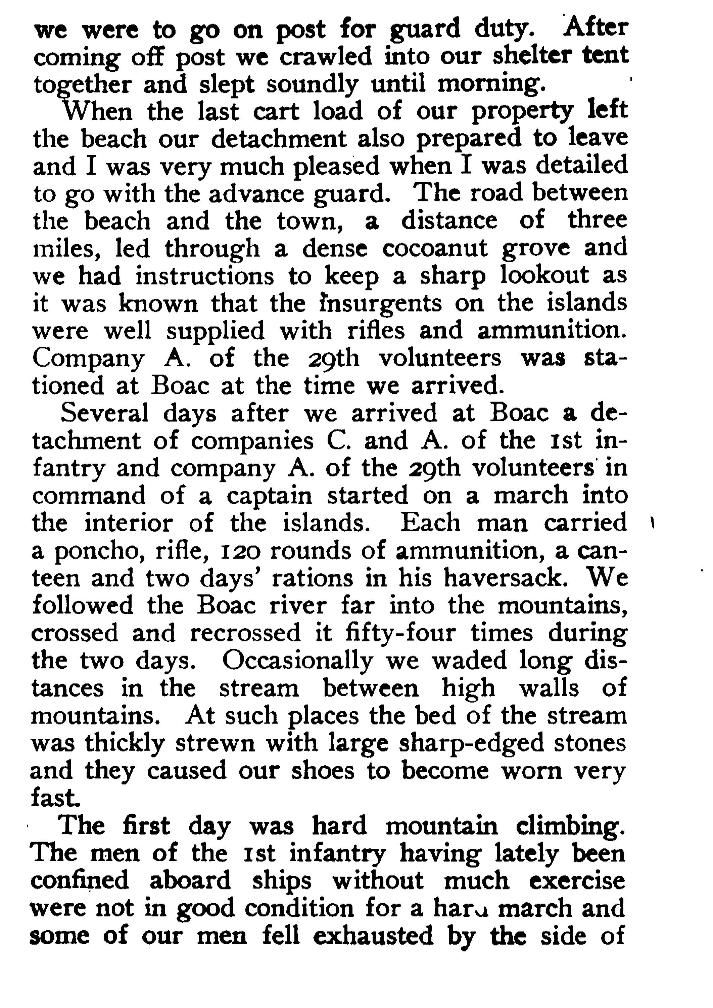
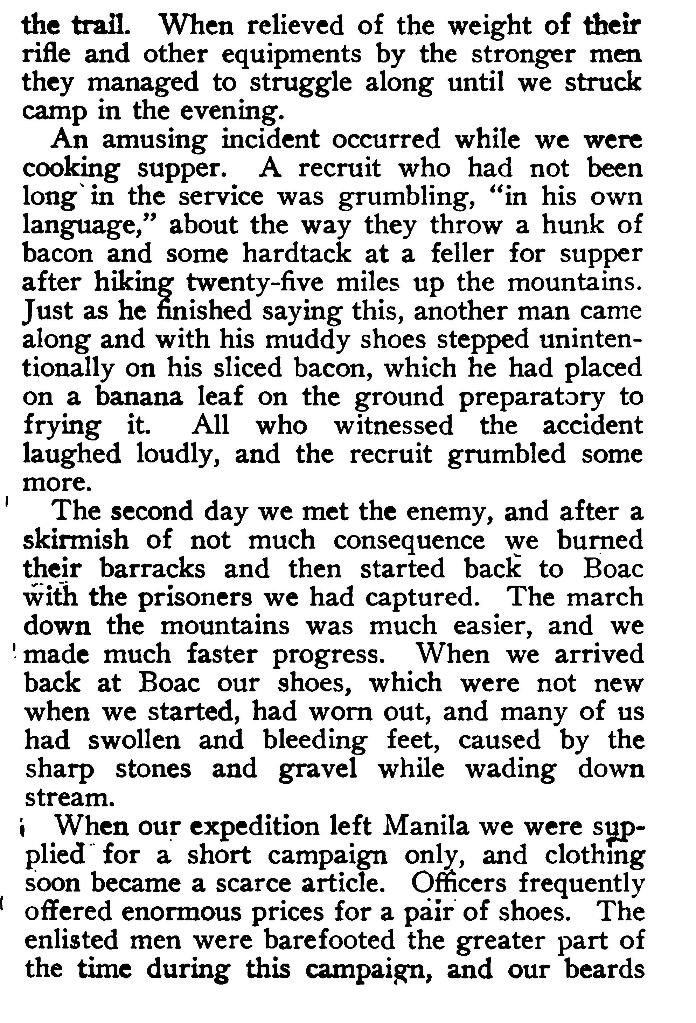
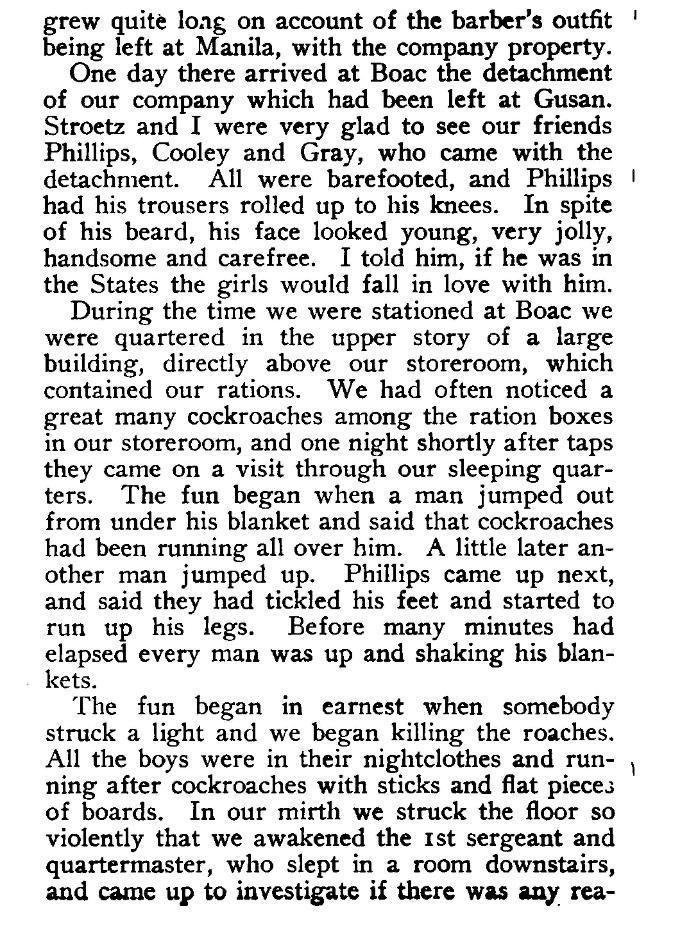

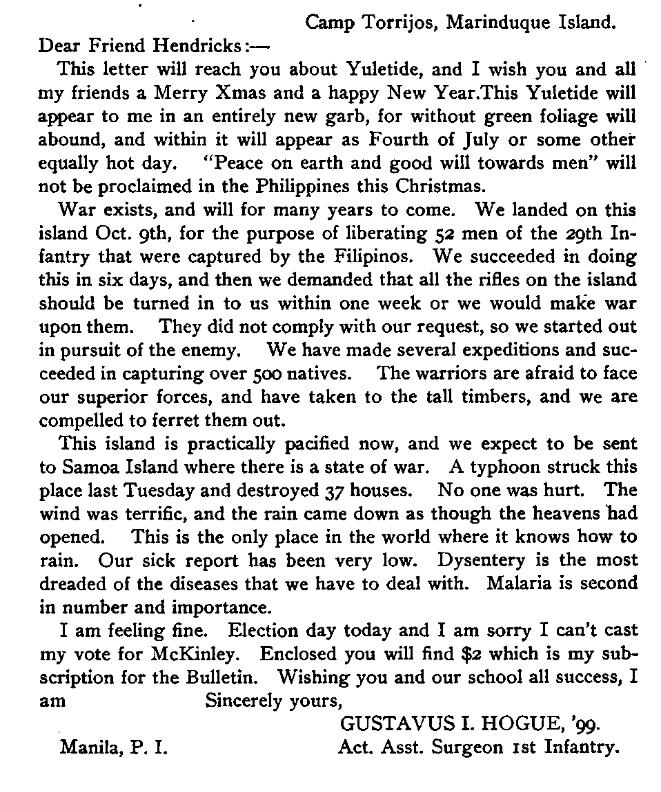
| New Albany Tribune, New Albany, Indiana August 16, 1901 Soldier’s Letter Arch Norrington’s Impressions of the Philippines Arch Norrington, of this city, who is a private in Company K, second United States Infantry, now stationed on the island of Marinduque, P.I., has written a letter to his mother in this city, portions of which will be interesting to the readers. He says: Most of the hardest fighting now is being done on Southern Luzon Island, which is the largest in the Philippine group. But I believe this island we are on is the roughest and has more mountains for its size than any other. We have been over most all of them. People in the states think it is nice to be in the Philippines, but I would rather be in old Indiana. It is not so nice when your sleeping sound to be awakened about midnight to go on a “hike” or in other words, a march, especially when you start with three days rations, consisting of three pounds of bacon, hard tack and coffee, and be out in the hills and mountains for six days, which was the case on our last march. For three days we had to live on wild sweet potatoes. Neither is it so nice when night comes to have your clothes wet from wading rivers and sometimes camping in a pouring rain. No its not so pleasant as one would think. The Philippine Islands ar nothing but a bunch of trouble gathered together on the western horizon of civilization. The natives of this country are very industrious. Their chief occupations being trench building, the making of bolos and knives and the reloading of Remington cartridges. Their sport consists mostly of cock fighting. The finest mahogany grows here that I have ever seen. I have seen tress 6 and 7 feet through. One of them in the states would bring $2,000 very easy. The beast of burden in this country is the caribou. They are about as lively and active as the proverbial snail. On a three mile journey the driver takes 10 days rations, and if the journey is a hundred miles, the driver is in great danger of dying of old age before reaching his destination. I used to think the long eared mule was the slowest animal in existence but I have changed my mind since seeing the caribou travel and I believe they are the ugliest creatures I ever looked at. The natives live mostly on rice, they have rice stewed, rice fried, rice boiled, and rice. The marriage of the Filipinos is very impressive, especially when the wife is given the privilege of working as much as her husband desires. The clothing of the native consists of a flour sack tied round their waists and anything under 12 years of age, waits until next year for its clothing. I don’t think this country was ever intended for a white man to stop in any longer than he could help. And I for one, will get out of it as soon as my time expires and never stop till I strike Indiana once more. We have had several engagements since we have been here and I have been in 3 of them. I have had the good luck not to get even a scratch. The last scrap we were in we had one Corporal and one Private wounded. But they are getting along all right and now are out of danger, for which we are all glad for on of our men is worth a whole army of these black scoundrels they are fighting and don’t know what for. About two weeks ago we had a scrap lasting an hour and a half, but every time they attack us we have no show at all. They are always up on the mountains, and we are generally in the valleys or climbing up the mountains, so they can shoot right down on us. But we will catch them napping some day. Up till last night I was out thirteen days. We had just gotten in off a seven day “hike” one morning, that evening we started right out again. Tomorrow is muster and we start out again tomorrow night. I think if we can get after them once or twice more they will be willing to come in and surrender. They are almost starved out. The only pleasure we have over here is when we get a drove of them started over a mountain, but they soon get out of our sight as they get over the mountains much faster than we can, though we have the pleasure of dropping a few of them anyway. This island we are on is only 22 miles each way and it is estimated there are 2,000 insurgents and only 450 American troops. The chief exports from these islands are rice, sugar, and sick soldiers. The chief imports are soldiers, ammunitions, arms, tobacco and beer. I am yours very truly. Private Arch Norrington Co. K, 2nd Vol. Inf., USA Manila, PI |
| The Leavenworth Times, September 3, 1901 WORK OF THE FIRST INFANTRY IN THE PHILIPPINES Regiment Has Seen Active Service Since Its Arrival Constantly On The Move On Arrival at Manila the Regiment Learned of the Capture of Captain Shields and Fifty- three Men – Was transferred from One Transport to Another and Started on Rescue Trip – Captain Getty in Command of Expedition Which Destroyed Filipino Barracks. I must crave your pardon for my delay in mailing you the movements of this company, since we left Leavenworth, Kan., but the fact is, we have been continually on the move since we arrived in Manila. We arrived at Guam Island on the morning of September 25 and anchored there just long enough to transfer the mail, then set sail for Manila. We arrived at Manila, P.I., on Monday morning, October1st, when we learned of the capture of Captain Shields and 52 . We were transferred from the transport Logan to the transport Sumner on Saturday afternoon, October 6th, when we received orders to proceed to Marinduque Island, to reinforce Company A, 20th Infantry and to re-capture the above named captain and 53 men. We sailed from Manila on Sunday afternoon at 3 p.m., and arrived at Santa Cruz, Marinduque Island on Monday morning at 8 a.m., where Company B disembarked. We then proceeded to Tryos (Torijjos) where Companys F, G, and H disembarked. We then proceeded to Gazan, where Companies D,E, and a detachment of Company C disembarked, (50 men commanded by Lieutenant Pickering) then Company A, the remainder of Company C, and headquarters, transferred from the transport Sumner to the “Venus” (chartered by the United States). From there we started to Boac, but a typhoon arose and we were ordered back to Santa Cruz. In the meanwhile, General Hare (who is in command) issued an order to the Filipinos that if they failed to deliver up their prisoners with forty-eight hours he would destroy every town on the island. We then left Santa Cruz, for Boac, and while enroute sighted a flag of truce at town by name “Buena Vista”. We started in and anchored and the gunboat “Bennington” sent in a number of small boats where a few of the Filipino officers surrendered their prisoners; Captain Shields was then taken on board the gunboat as he was slightly wounded the rest of the men were taken aboard the “Venus” and sent to rejoin their companies. We then proceeded to Boac, arriving there on the morning of October 18, and had a two mile march to the town where we were quartered in the government palace. We started on an expedition on the morning of October 20 to destroy a Filipino barracks; we started at 6 a.m. with a detachment of Company A, 29th volunteer infantry, and three days rations. We crossed a stream (one of the boys counted it) 80 times. We were traveling in a zig-zag fashion, and struck parts of the trail where the sun never shone. We waded one river the current was so swift it was with difficulty we could keep our footing. After crossing the streams we struck the mountains, and were climbing them for a whole day. We had Chinamen with us acting as pack horses, they were continually playing out, which was a God-send to us, as we were on the verge of giving out ourselves, as we had to carry the Chinamen’s luggage when they gave out. We managed to creep on until about 5 p.m., when Capt. Getty (who was in command of the expedition) ordered a halt, and we camped for the night, throwing out-posts all around the camp. Reveille sounded at 4 a.m., and we continued on our march for the Filippino barracks. After taking three prisoners where we halted the night before and while en route to the barracks. One of the men in the rear guard set fire to one of the houses. After a while one of the guides discovered that we were on the wrong trail so we turned around and retraced our way until we came to the house which was fired, when we captured two natives making an effort to extinguish the flames; after four or five more hours of marching we reached the barracks but found the deserted. We then set fire to it and started on our return march. We ran across a number of goo-goos (as we call the natives) and fired on them, but they escaped and we arrived in town about 4 p.m. after three days hard marching, having accomplished our mission. On the afternoon of the 23rd of October we started on another expedition to destroy a town (name not known), we arrived at a town by the name of Mog Pog, capturing about 100 natives. We then marched about five miles west, then for some cause unknown retraced our way back to Mog Pog. We then drove the natives out of their huts and took possession for the night. We started again at day break and the march was uneventful until we reached the town and found it deserted, the natives having but just fled, as we could see traces of recent occupation. We then destroyed the town, had dinner and started on our return march. We arrived at Mog Pog at 3:30 p.m., and destroyed the town, leaving the church. Then resuming our march, we arrived at headquarters about dusk. On the morning of October 31at a terrible storm swept the island, tearing down houses and destroying cocoanut groves. The natives were terror-stricken, as it was the most destructive typhoon that had swept the island for a number of years. News came to us of serious outbreaks on Samar Island, about 300 miles south of Marinduque when we received orders to proceed to reinforce two companies of 2nd Infantry, two companies 29th volunteers and 1st battery of artillery. We left Boac on the morning of the 9th of November boarding the German tramp steamer Petrarch (chartered by the United States). We started with 400 prisoners to a small town opposite Santa Cruz, where the prisoners were turned loose. We then proceeded to Tryos (Torijjos), taking on board companies F, G, and H, but previous to our departure the town was discovered to be in flames. We then proceeded to Samar Island. Charles W. Pons Company C, 1st Infantry |
| The Covington Republican, Covington, Indiana, November 8, 1901 The Philippines Don Adamson, a Covington Boy Writes An Interesting Letter Manila, Sept. 29, 1901. Marinduque is entirely a different island, very small, and lies near the coast of Tayabas province. It was here, a year ago that one whole company of 29th Inft. Vols., was captured. After their release and more campaigning the insurgents were induced to surrender, and soon everything was peaceful. I landed at Boac, the capital where two companies of the 30th inf. U.S. Army is stationed. Here I found a very pretty little city. A large, magnificent church rested upon a high hill which overlooks the town in which the soldiers are garrisoned. Marinduque has civil government, their own governor, treasurer and secretary, police force and insular constabulary, and American schools. Here I found a very intelligent community and every one eager to learn the English language. There is a crowd of about forty young ladies who go together and they all can speak English exceedingly well. The girls school has over two hundred and the boys and equal number. Boac is about two miles inward from the coast. From Boac I drove eighteen miles south along the coast to Gazan, a very pretty little coast town. Here were two companies of soldiers, but it also had local government. About fifteen miles around the south coast is another garrisoned town called Treons (Buena Vista). I did not go there. Near Treons is a very fine sulpher spring. One other important town on the island is Santa Priuz (Santa Cruz), near the east coast. Marinduque is a much favored island. It has the distinction of producing the finest hemp in the world. It also is rich in cocoanut groves. The hills, streams and valleys contain wealthy deposits of sulpher, iron, and gold ore, which, when developed will make the island more important. Much fine timber is to be found among the mountains, and many cattle are raised. Marinduque is only a few hours run from Lucena, Tayabas Province and from Tayabas City I used to see it every day. Don Adamson Checker, U.S. Transportation Service. |