| World War 2 News and actions in an around Marinduque |
 |
 |
| THIS PAGE UPDATED Oct 21, 2015 |
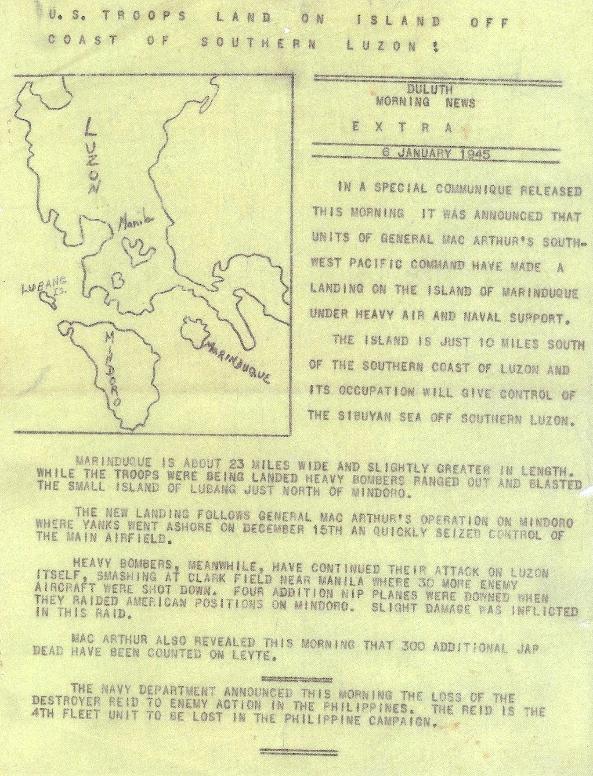
Gen. McArthur's Headquarters, Philippines Jan. 6 - (Saturday)-(AP)-
The unopposed American landing on Marinduque island Wednesday (Philippine time) in a new liberation
step toward Luzon, principal Philippine island, was announced today by Gen. Douglas MacArthur.
Marinduque, approximately 20 by 25 miles in size is only 12 miles from the Tayabas peninsula on Luzon.
The communiqué said the seizure gave the Americans "control of the Sibuyan Sea and established direct
contact with the southern Luzon coast".
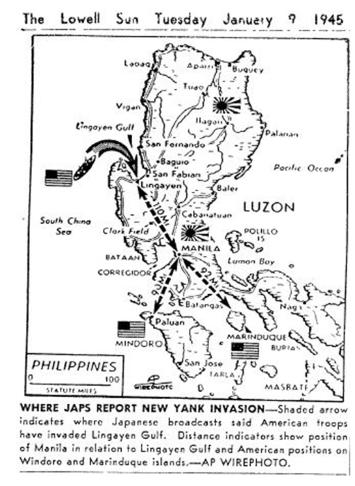
The landing was at Buenavista on the southwest coast approximately 20 miles east of Mindoro island
invaded by the Yanks December 15 and 100 miles southeast of Manila .
A headquarters spokesman said the interior of the island is virtually impassable, but a highway runs 15
miles north and south along the beach itself on the west coast.
Seventh Island Landed On
Marinduque is the seventh island of the Philippines on which American forces have landed in the two and
half months campaign to liberate the archipelago. It is the third within long range gun distance of Luzon.
The nearest points on MIndoro and Samar are less than 15 miles from southern Luzon.
Other islands which previously felt the tread of American soldiers are Leyte, Panson, Dinagot, and
Homonhon.
The day of the landing also saw American planes hitting hard at Japanese airdromes throughout the
Philippines and other southwest Pacific islands. Mitchells and Liberators heavily bombed Clark Field's
airdromes in daylight Thursday destroying 30 parked planes. A single Nipponese plane over Clark Field
was the first enemy attempt at interception since January 1.
A force of Liberators and P-40 fighter planes hit Limbones island in Manila Bay in daylight the previous
day.
Air and Naval units supported the Marinduque landing the communiqué said.
Raid Are Of Airdromes
The seizure of Marinduque came one day after MacArthur's announcement that American troops had
made additional landings without opposition on the east and west coasts of Mindoro Island.
Japanese planes continued their persistent night attacks on American installations on Mindoro Island,
doing some damage but losing four aircraft.
American airmen maintained their pounding of Japanese airfields in the central and southern Philippines,
bombers and fighters striking dromes on Negros, Panay and Mindanao islands.
Allied medium bombers and fighter bombers dropped 30 tons of bombs on Nipponese personnel and
supply areas on Halmahera, Ambon, Boeroe, and Ceram islands in the Moluccas, while other aircraft
harassed Japanese encampments in the Tanimbar islands and in the Wewak sector New Guinea.
Enemy airdromes and troop concentrations near Kavieng, New Oreland Island in the Bismark archipelago
were hammered with 34 tons of explosives which set of explosions and fires.
This Summary of the Deck Log of the USS LCI (L) 750 was compiled in memory of the fine crew who
sailed this rugged little vessel through the elements to the enemys shores and returned her home. To the
crew, the ship and the Americans who designed and built he. Herein is a summary of daily log entries
taken from the Deck Log of the USS LCI (L) 750 at the National Archives in Adelphi, Maryland. All
notations in Italics are personal observations of B. L. Pettit, member of the crew.
10 March 1945 - Beached Laylay, Marinduque Island. Henry Stewart, StM 3/c went ashore and was
brought aboard under arrest on charges of resisting arrest, attempting to strike a superior officer and the
usage of abusive, obscene and threatening language to superior officer. Prisoner placed in solitary
confinement for safety of ship. Acquired a small dog from island and named him Duke. Underway from
Marinduque Island to Tablas Island. Also had a monkey aboard named Jocko.
21 May 1945 - Supplies and 25 Army officers came aboard. Underway to Marinduque, PI. Beached at
Marinduque.
23 May 1945 - Passengers aboard. Underway for Marinduque. Beached. Passengers disembarked.
Underway to Mangarin Bay, Mindoro. Beached at Bubug Point, Mangarin Bay.
FROM THE BOOK THE THIRTEEN YEAR OLD SAILOR. Pettit
On 9 March, (1945) we got underway independently for Marinduque Island, and beached at Laylay. Henry
Stewart, a black Stewards Mate who had been in and out of trouble the whole time he had been aboard,
went ashore and got into trouble with some army troops. They sent a message back to the ship that if we
wanted this fellow back alive, we had better come and get him, otherwise they were going to kill him.
Lt.(j.g.) Bradley was dispatched to bring him back to the ship. Bradley came back with Stewart, but Stewart
did not want to come aboard. Bradley had a sidearm and told Henry Stewart he had to the count of three to
get aboard, otherwise, Im going to kill you right here. Stewart had previously threatened to throw a hand
grenade into the crews quarters but was stopped when someone told him his friend, James McBurnie, was
down there. On another occasion, Stewart had picked up a Japanese rifle somewhere and I recall seeing
him with the rifle walking on the beach as though he was squirrel hunting. All the crew was topside looking
down at this stand-off between Lt. Bailey and Stewart and wondering what would happen when Lt. Bradley
got to three. Lt. Bradley got to three and pulled out his sidearm. Stewart turned white and headed up the
ramp. He was charged with resisting arrest, attempting to strike a superior officer, and the use of abusive
and threatening language to a superior officer. He was then put in solitary confinement for the safety of the
ship. When we arrived back at Mindoro Island on 13 March, Henry Stewart was taken ashore under guard.
London Stars & Stripes August 13, 1945
Army 'Discharges' Girl Who Fought as a Boy Guerilla MANILA; Aug. 12 Maj. Gen. William H. Gill,
commanding the 32nd Infantry Division, gave an honorable discharge yesterday to 13-year-old Virginia
Weems, who posed as a boy and served three years with Filipino guerrillas. Virginia, whose father was an
American, and mother a Filipino, was born on Marinduque Island, near Mindoro. Her widowed mother was
interned at Santo Tomas by the Japanese when the war broke out. Virginia donned boy's clothes and
joined a guerrilla medical unit attached to the 32nd division. Virginia served through fighting in Northern
Luzon and was credited with killing five Japs. She still wears a khaki uniform because she has been
unable to get a dress at the convent in Cayagayen Valley, where she is studying to be a concert pianist.
The unopposed American landing on Marinduque island Wednesday (Philippine time) in a new liberation
step toward Luzon, principal Philippine island, was announced today by Gen. Douglas MacArthur.
Marinduque, approximately 20 by 25 miles in size is only 12 miles from the Tayabas peninsula on Luzon.
The communiqué said the seizure gave the Americans "control of the Sibuyan Sea and established direct
contact with the southern Luzon coast".
The landing was at Buenavista on the southwest coast approximately 20 miles east of Mindoro island
invaded by the Yanks December 15 and 100 miles southeast of Manila .
A headquarters spokesman said the interior of the island is virtually impassable, but a highway runs 15
miles north and south along the beach itself on the west coast.
Seventh Island Landed On
Marinduque is the seventh island of the Philippines on which American forces have landed in the two and
half months campaign to liberate the archipelago. It is the third within long range gun distance of Luzon.
The nearest points on MIndoro and Samar are less than 15 miles from southern Luzon.
Other islands which previously felt the tread of American soldiers are Leyte, Panson, Dinagot, and
Homonhon.
The day of the landing also saw American planes hitting hard at Japanese airdromes throughout the
Philippines and other southwest Pacific islands. Mitchells and Liberators heavily bombed Clark Field's
airdromes in daylight Thursday destroying 30 parked planes. A single Nipponese plane over Clark Field
was the first enemy attempt at interception since January 1.
A force of Liberators and P-40 fighter planes hit Limbones island in Manila Bay in daylight the previous
day.
Air and Naval units supported the Marinduque landing the communiqué said.
Raid Are Of Airdromes
The seizure of Marinduque came one day after MacArthur's announcement that American troops had
made additional landings without opposition on the east and west coasts of Mindoro Island.
Japanese planes continued their persistent night attacks on American installations on Mindoro Island,
doing some damage but losing four aircraft.
American airmen maintained their pounding of Japanese airfields in the central and southern Philippines,
bombers and fighters striking dromes on Negros, Panay and Mindanao islands.
Allied medium bombers and fighter bombers dropped 30 tons of bombs on Nipponese personnel and
supply areas on Halmahera, Ambon, Boeroe, and Ceram islands in the Moluccas, while other aircraft
harassed Japanese encampments in the Tanimbar islands and in the Wewak sector New Guinea.
Enemy airdromes and troop concentrations near Kavieng, New Oreland Island in the Bismark archipelago
were hammered with 34 tons of explosives which set of explosions and fires.
This Summary of the Deck Log of the USS LCI (L) 750 was compiled in memory of the fine crew who
sailed this rugged little vessel through the elements to the enemys shores and returned her home. To the
crew, the ship and the Americans who designed and built he. Herein is a summary of daily log entries
taken from the Deck Log of the USS LCI (L) 750 at the National Archives in Adelphi, Maryland. All
notations in Italics are personal observations of B. L. Pettit, member of the crew.
10 March 1945 - Beached Laylay, Marinduque Island. Henry Stewart, StM 3/c went ashore and was
brought aboard under arrest on charges of resisting arrest, attempting to strike a superior officer and the
usage of abusive, obscene and threatening language to superior officer. Prisoner placed in solitary
confinement for safety of ship. Acquired a small dog from island and named him Duke. Underway from
Marinduque Island to Tablas Island. Also had a monkey aboard named Jocko.
21 May 1945 - Supplies and 25 Army officers came aboard. Underway to Marinduque, PI. Beached at
Marinduque.
23 May 1945 - Passengers aboard. Underway for Marinduque. Beached. Passengers disembarked.
Underway to Mangarin Bay, Mindoro. Beached at Bubug Point, Mangarin Bay.
FROM THE BOOK THE THIRTEEN YEAR OLD SAILOR. Pettit
On 9 March, (1945) we got underway independently for Marinduque Island, and beached at Laylay. Henry
Stewart, a black Stewards Mate who had been in and out of trouble the whole time he had been aboard,
went ashore and got into trouble with some army troops. They sent a message back to the ship that if we
wanted this fellow back alive, we had better come and get him, otherwise they were going to kill him.
Lt.(j.g.) Bradley was dispatched to bring him back to the ship. Bradley came back with Stewart, but Stewart
did not want to come aboard. Bradley had a sidearm and told Henry Stewart he had to the count of three to
get aboard, otherwise, Im going to kill you right here. Stewart had previously threatened to throw a hand
grenade into the crews quarters but was stopped when someone told him his friend, James McBurnie, was
down there. On another occasion, Stewart had picked up a Japanese rifle somewhere and I recall seeing
him with the rifle walking on the beach as though he was squirrel hunting. All the crew was topside looking
down at this stand-off between Lt. Bailey and Stewart and wondering what would happen when Lt. Bradley
got to three. Lt. Bradley got to three and pulled out his sidearm. Stewart turned white and headed up the
ramp. He was charged with resisting arrest, attempting to strike a superior officer, and the use of abusive
and threatening language to a superior officer. He was then put in solitary confinement for the safety of the
ship. When we arrived back at Mindoro Island on 13 March, Henry Stewart was taken ashore under guard.
London Stars & Stripes August 13, 1945
Army 'Discharges' Girl Who Fought as a Boy Guerilla MANILA; Aug. 12 Maj. Gen. William H. Gill,
commanding the 32nd Infantry Division, gave an honorable discharge yesterday to 13-year-old Virginia
Weems, who posed as a boy and served three years with Filipino guerrillas. Virginia, whose father was an
American, and mother a Filipino, was born on Marinduque Island, near Mindoro. Her widowed mother was
interned at Santo Tomas by the Japanese when the war broke out. Virginia donned boy's clothes and
joined a guerrilla medical unit attached to the 32nd division. Virginia served through fighting in Northern
Luzon and was credited with killing five Japs. She still wears a khaki uniform because she has been
unable to get a dress at the convent in Cayagayen Valley, where she is studying to be a concert pianist.
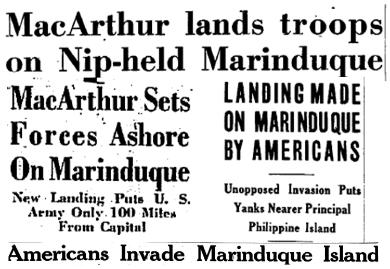
| AP Story lines flashed to newspapers all over the United States |
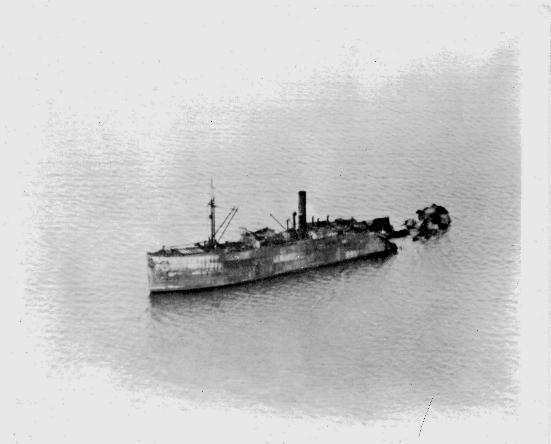
| 6000 ton Fox Class Japanese Transport bombed near Marinduque, 15 Nov 44 ComAir 7th Flt Photo |
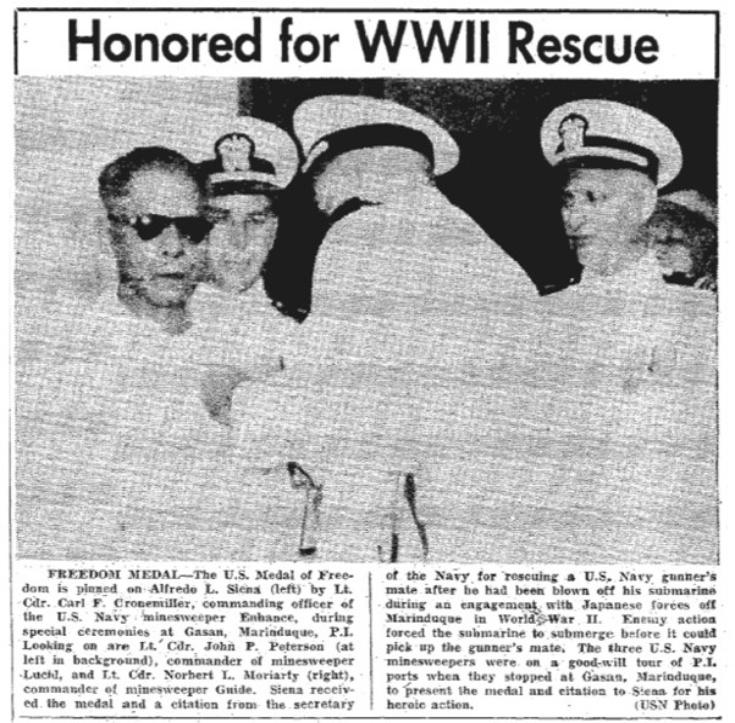
In the 1960's, Marinduque resident Alfredo L. Siena was awarded the U.S.
Medal of Freedom for rescuing a U.S. gunner's mate who was washed off
his submarine near Marinduque during WW2. Was the rescued sailor
Rudolph Velle from the USS Gunnel? For a complete report on what
happened , please visit Jim Lavelle's USS Gunnel site @
http://www.jmlavelle.com/gunnel/patrol6.htm and page down to August 18,
1944, 15:01 hrs.
Medal of Freedom for rescuing a U.S. gunner's mate who was washed off
his submarine near Marinduque during WW2. Was the rescued sailor
Rudolph Velle from the USS Gunnel? For a complete report on what
happened , please visit Jim Lavelle's USS Gunnel site @
http://www.jmlavelle.com/gunnel/patrol6.htm and page down to August 18,
1944, 15:01 hrs.
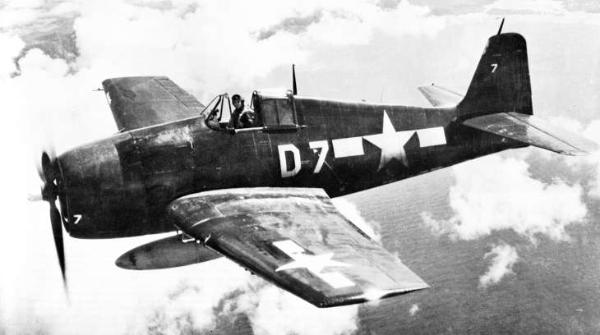
On October 27, 1944, Lieutenant Naoshi Kanno led a mixed group of seventeen
planes from Clark Field down to Cebu to reinforce the 201st Air Group's suicide
operations. On the way down, over Marinduque Island, the Japanese formation
encountered sixteen F6F's. Zeros of his unit were new for the most part, and there
were also several of the even newer Shiden (Kawasaki NIKI-J fighters) known to
the Americans as Georges. These planes were superior to the Zero in armament
and speed, and at the time were generally unfamiliar to the Americans.
Perhaps that is why the air battle over Marinduque turned out as it did, a complete
route of the Americans. The Japanese that day claimed to have shot down twelve
F6F's with the loss of a single plane.
planes from Clark Field down to Cebu to reinforce the 201st Air Group's suicide
operations. On the way down, over Marinduque Island, the Japanese formation
encountered sixteen F6F's. Zeros of his unit were new for the most part, and there
were also several of the even newer Shiden (Kawasaki NIKI-J fighters) known to
the Americans as Georges. These planes were superior to the Zero in armament
and speed, and at the time were generally unfamiliar to the Americans.
Perhaps that is why the air battle over Marinduque turned out as it did, a complete
route of the Americans. The Japanese that day claimed to have shot down twelve
F6F's with the loss of a single plane.

Lt. Naoshi Kanno
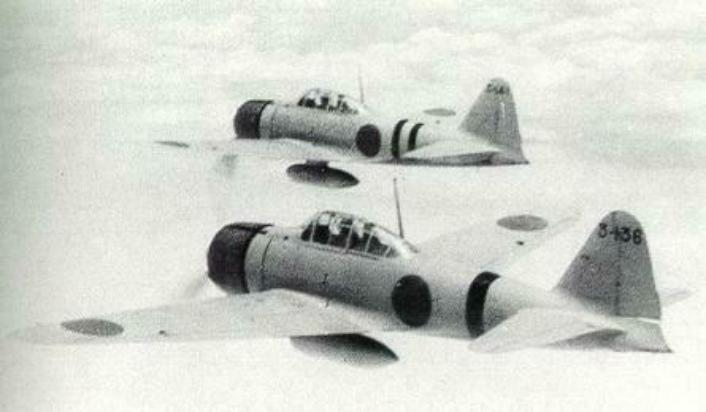
Japanese Zero
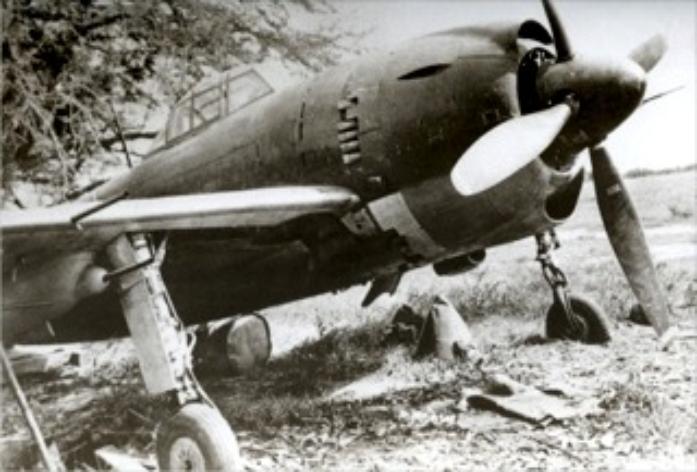
Japanese George
| American F6F |
| Shipboard newspaper from the USAMRS Deluth |
| * |